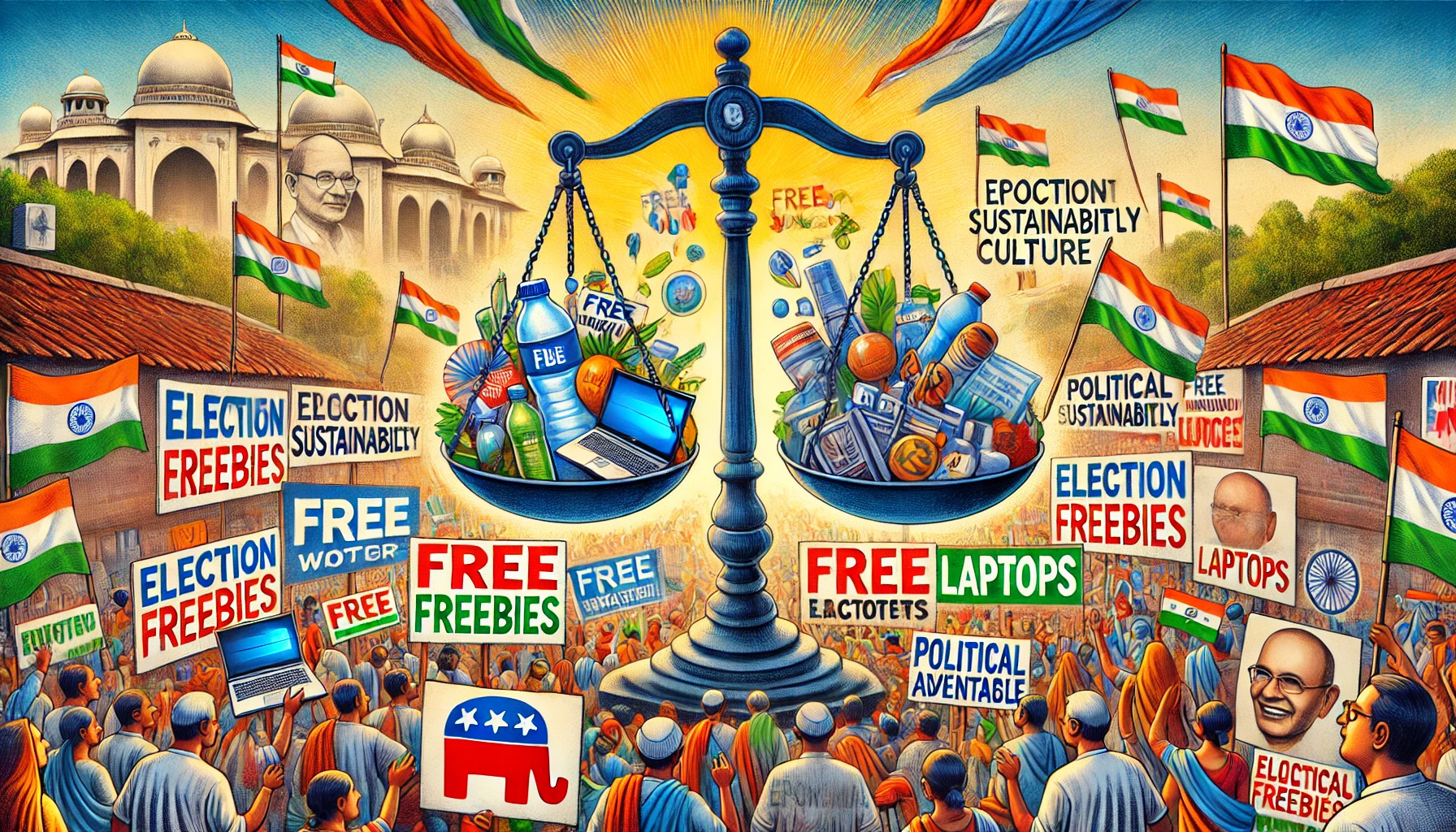
The Indian democracy showcases a vibrant culture which during election time garners a lot of attention and political parties tend to safeguard their vote share through election promises. One such promise is ‘freebies,’ the most common incentive that is offered and practiced today. While there are steps that can be taken to assist certain groups within the country, such as offering freebies, they do bring about serious concerns in regard to whether the economy would be able to withstand them in the future. This article delves into the dual-edged nature of election freebies, examining whether they represent astute political maneuvering or pave the way for economic turmoil.
The Genesis of Freebie Culture in India
Freebie culture is not new to India and dates back to offering uncommon political practices such as the distribution of subsidized food grains, clothing, and any other basic amenity during the 1960s and 1970s to entice citizens towards voting. When trying to recall what people voted in elections, political parties are now well acquainted with the idea of offering things like televisions, laptops, and even household appliances, because who does not want such tangible things? The goal is crystal clear: help those most in need and get the vote.
The Political Appeal of Freebies
In politics, freebies are highly appetizing at many levels because, for example,
- Immediate Gratification: First, free programs appeal to the feelings of voters which in turn makes them favorable towards the political party. This captures the attention of the voters.
- Vote-Bank Consolidation: Second, free gifts offered can be aimed towards certain targeted groups which helps a political party to strengthen its vote bank.
- Differentiation: Third, extraordinary or oversized free giveaways can strategically place a political party above competitors in the field of politics that has a lot of competitors.
These tactics have been used throughout the states, with many parties aiming their promises towards local expectations and needs.
Economic Implications of Freebies
Although the political benefits are clear, the economic impact of implementing the free programs is worrying:
- Free Rollout: These large gifts require major public spending. The party implementing the free programs increases the fiscal deficit which leads the government to borrow more, and cut health and education budgets.
- Freebies: These gifts have the potential to increase public debt exponentially. As stated in a report by The Tribune, “These gifts come at an economic expense India can not afford.
- Reallocation of Funds: A large sum of funds directed towards enabling these programs, distracts the long term development projects and infrastructure building.
- Excessive spending: With a lack of revenue to back it up, can be monetary policy with inflation goals and it can ultimately erode the overall purchasing potential of citizens.
Case Studies: Freebies in Practice
Tamil Nadu
Government by government, free items have been awarded. Electronics and even cattle have been given during elections. Critics claim that these steps do help the poor, but these steps have major roadblocks in sustainable fiscal growth.
Delhi
The AAP’s policies include free bus riding for women, a set amount of free electricity, and free water supply. These seem practical, promoting inclusivity, but many question if these measures are reasonable in the long haul and if they will burden the treasury of the state.
The Legal and Ethical Debate
The issues surrounding how election free gifts are awarded raises some questions: are they legal or ethical?
- Supreme Court’s Stance: The Freebies Campaign has already been challenged in the Supreme Court, where it has accepted that these offerings can disturb free election practice. However, establishing where public interest stops and freebie populism starts is not easy.
- Policy Implications: There’s active ongoing discussions on creating policies to control the offering and publicity of freebies so as not to undermine the economic condition and democratic principles of a country.
Striking a Balance: Welfare vs. Freebies
It is necessary to differentiate between welfare policies and election based freebies.
- Welfare Schemes: These are strategically designed socioeconomic policies targeted for long range goal attainment like employment assurance, health care, and education grants or scholarships.
- Freebies: These are voted based gerrymandered policies gifted with no plan of action behind them. Most of these occur to bait voters during elections.
Policymakers should look to create welfare schemes for the citizens that encourage self sustainment instead of mindless freebies that promote dependency.
Conclusion
Election freebies remains a debatable issue when it comes to India – from the democratic perspective and economical perspective. While there are political short term covers for a particular group and immediate gain, the economic impact shoulders over it. It is critical to shift to actionable policies that focus on growth, development, low fiscal spending, and real welfare policies.
FAQs
What are election freebies, and why do political parties offer them?
Election freebies are incentives like free electricity, water, household appliances, and cash transfers offered by political parties to attract voters and secure vote banks.
How do freebies impact the economy?
Freebies increase public spending, contribute to fiscal deficits, and may divert funds from essential sectors like healthcare and infrastructure, potentially harming long-term economic growth.
Are election freebies legal in India?
While freebies are not illegal, they have been challenged in the Supreme Court due to concerns over financial sustainability and their impact on free and fair elections.
What is the difference between welfare schemes and election freebies?
Welfare schemes are structured programs aimed at long-term socio-economic growth, while freebies are short-term incentives given during elections without a sustainable development plan.
Which Indian states have a strong culture of election freebies?
States like Tamil Nadu and Delhi have seen frequent use of election freebies, including free electricity, water, transportation, and even consumer goods like laptops and televisions.