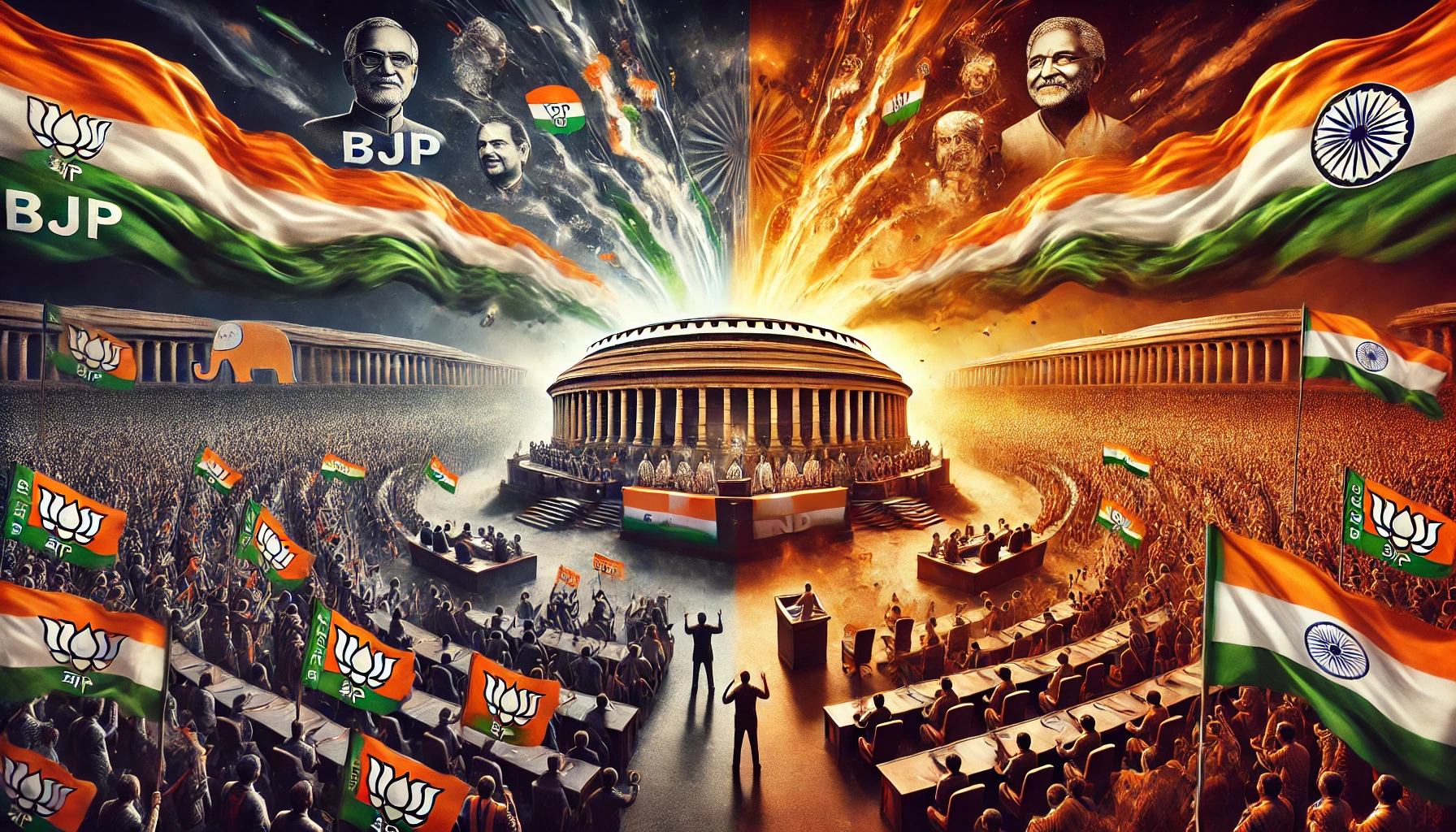
The 2024 Indian elections turned out to be one of the most important and hotly fought political contests in the country’s history. The Prime Minister’s party, the Bharatiya Janata Party (BJP), and the opposition, known as the INDIA (Indian National Developmental Inclusive Alliance), fought to secure a key position in Indian politics. This election transformed the regional politics of the country and showcased the new importance of coalition politics.
Results Analysis: What Do the Numbers Say?
The numbers released on the 4th and 5th of June 2024, certainly transformed the political landscape of India with some of the results being better and the rest not so good.
- The BJP led NDA (National Democratic Alliance) got 293 seats, still a majority, but lost many compared to what the alliance won in 2019.
- The , which is very far from the much needed 272 seats. BJP has to depend on its allies now.
- The 234 seats for the INDIA bloc translated into the most powerful opposition in Britain and marked important juBJP by itself grabbed only 240 seatsmping points for the party.
- Congress surpassed its last elections by getting 99 seats, which shows the party is coming back to life.
These results demonstrate that the BJP government led by Modi had a greater challenge this time round. The opposition alliance packed all their votes which posed a huge challenge for MODI.
State-Wise Performance and Key Highlights
Uttar Pradesh – A Major Setback for BJP
BJP’s stronghold of Uttar Pradesh saw some severe political realignments lately. Starting the year 2022 with crucial elections, the Samajwadi Party (SP) has emerged as the largest melter of BJP supremacy. The State Bloc’s collective management was commendable, resulting in one of the worst performances of BJP in the state over the past elections.
West Bengal – TMC Holds Ground
Mamata Banerjee and her TMC managed to weather BJP’s hugged campaign, retaining their control over the state and winning the majority of seats to ensure that BJP’s foothold in the State remained restricted. It also includes countering relatively weaker regional parties.
Maharashtra – A Resurgence of Opposition
A consolidated victory for the INDIA alliance came in Maharashtra owing to the united Shiv Sena (UBT), Congress and NCP (Sharad Pawar’s faction) which tremendously cut down the seat share for BJP and made it evident that the state was still inclined towards local parties.
South India – BJP Struggles
In South India, BJP suffered humiliation in the three major states of Tamil Nadu, Kerala, and Karnataka. The Dravida Munnetra Kazhagam (DMK) and Congress alliance candidate won rest of the seats in Tamil Nadu, while the Left and Congress retained their stronghold over Kerala.
Campaign Strategies: BJP vs. INDIA Bloc
BJP’s Strategy – Modi Factor & Hindutva Politics
The primary components of the BJP campaign were anchored on prominent PM Narendra Modi’s leadership, nationalism, and development policies. Some of them were:
Strong national security narrative: India’s strengthening military power and border inflating.
Hindutva and Ram Mandir: Ayodhya was helpful in helping the elections as regards to the so-called grand inauguration of Ram Mandir.
Economic and infrastructure push: Special emphasis on a motorway, Vande Bharat trains, Expressways, and Digital India.
Targeting Rahul Gandhi & Opposition’s Unity: BJP tried to brand the INDIA bloc as a coalition of corrupt dynasties.
Even after these measures, local issues together with anti-incumbency activities depleted BJP’s strength in a good number of regions.
INDIA Bloc’s Strategy – Anti-BJP Unity & Social Justice
The major opposition parties Congress, AAP, SP, TMC, DMK, and RJD combined to form the INDIA Bloc and fought elections with a unified “against BJP” slogan. Their core themes were:
- Protecting democracy & constitutional values: Accusing BJP for attacking democratic institutions.
- Economic concerns: Focusing on inflation, unemployment, and agrarian distress.
- Caste census & social justice: Attracting lower caste people through caste based welfare policies.
- Targeting Modi government’s policies: Misuse of power and position in the federally trained central government through the body of CBI, ED, against opposition leaders.
The blast of the aggressive campaign centered on specific issues boosted INDIA Bloc’s support in important states like Uttar Pradesh, Maharashtra, and Bihar.
Key Factors That Decided the 2024 Election
1. Modi’s Popularity vs. BJP’s Decline
In support of Modi being the popular prime minister, BJP local leaders and their governing abilities were heavily criticized. With the persisted inflation and continuous rise of unemployment, some of the key states became less favorable for the BJP.
2. Regional Players Gaining Strength
SP in UP, TMC in Bengal, DMK in Tamil Nadu, and AAP in Delhi-Punjab emerged as regional political forces that effectively curbed BJP’s widespread influence due to their grassroots politics and analytical base reasoned decision making.
3. Caste Politics & OBC Mobilization
The caste census demand, as proposed by the INDIA Bloc, is one (of many) strategies used by the Congress to entice the other backward class and dalit voters, particularly against BJP’s Hindutva strategy, while still promoting “Jitni Abadi, Utna Haq”.
4. Role of Social Media & Misinformation
Both the BJP and the Supreme Court seized opportunities to twist facts and blur reality on social media, WhatsApp, and through deep fake videos to influence the votes. In essence, misinformation and AI manipulated footage became the central aspects of political propaganda for these elections.
5. Election Commission & Institutional Independence Debate
During the campaign significant accusations of tampering with EVMs and interfering with central agencies’ operations surfaced. While the INDIA Block accused the BJP of meddling, the BJP dismissed it as the opposition’s self-defeating excuse.
What Does This Means for India’s Political Future?
For BJP:
- Although BJP remains the largest party, their growing inability to secure a clear majority makes them increasingly vulnerable and less dominant.
- The government becomes more reliant on NDA partners like JD(U) and TDP, which increases coalition dependence.
- If economic and regional concerns are not addressed, then the 2029 elections will be even harder.
For INDIA Bloc:
- The presence of such strong opposition guarantees a more liberal democracy.
- The Congress resurgence is a significant pro, but being able to maintain coalition unity will be difficult.
- The race for 2029 already begins from now if they seek to capitalize on current bolstered support.
Final Verdict: A More Competitive Political Era
The 2024 elections changed the landscape of Indian politics because it signified the end of BJP rule politics and the return of strong opposition politics. The Modi’s leadership is tremendous, but INDIA Block truly managed to revive competition.
The biggest takeaway?
- No party is invincible.
- Regional politics is back in the game.
- 2029 will be an even bigger showdown!
FAQs
What was the outcome of the 2024 Indian elections?
The BJP-led NDA secured 293 seats, while the INDIA Bloc emerged as a strong opposition with 234 seats, marking a significant political shift.
Why did BJP lose seats in the 2024 elections?
BJP faced setbacks due to anti-incumbency, regional party strength, economic concerns, and the growing influence of caste-based politics.
How did the INDIA Bloc manage to challenge BJP?
The opposition alliance focused on unity, social justice, economic concerns, and anti-BJP messaging, which resonated with voters in key states.
Which states played a crucial role in the election results?
Uttar Pradesh, Maharashtra, West Bengal, and South Indian states significantly influenced the results by shifting away from BJP.
What are the political implications of this election for 2029?
With BJP losing its complete dominance, coalition politics will play a key role in shaping India’s future elections, making 2029 even more competitive.