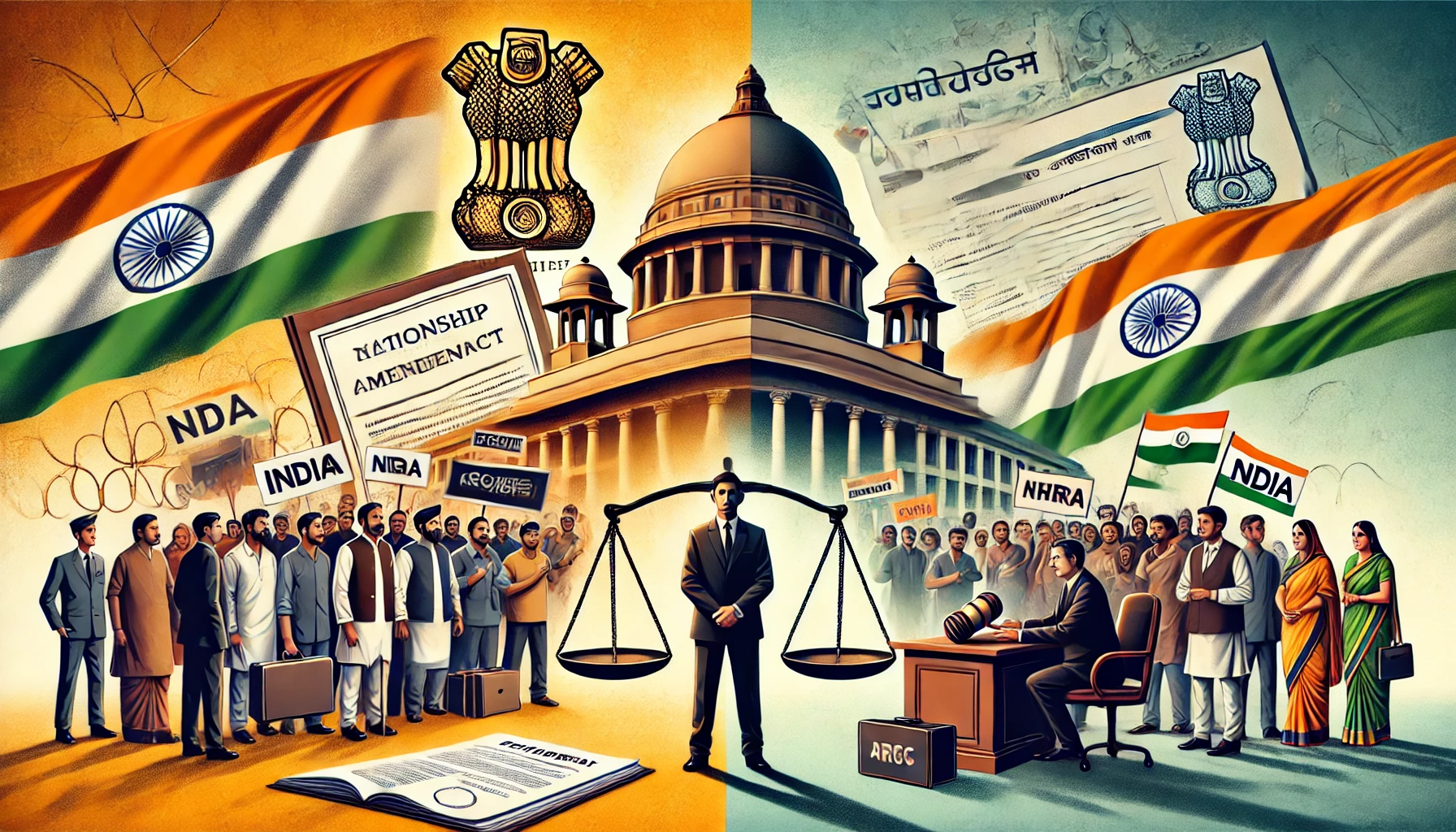
The introduction of the Citizenship Amendment Act (CAA) and the National Register of Citizens (NRC) has sparked intense discussions in the country, some of which the government is keen to act upon. Over the past few years, there has been a prominent focus towards the CAA and NRC which resulted in massive debates at an international level. The CAA and NRC policy plans need to be executed delicately keeping in mind the motivations, consequences, and political factors running out from these policies.
Understanding The Citizens Amendment Act (CAA) and The National Register of Citizens (NRC).
Citizenship Amendment Act (CAA): There were many changes made to the Citizenship Act of 1955. One of the more significant changes was made in December of 2019 with the introduction of CAA, which allows non-Muslim minorities from Afghanistan, Pakistan, and Bangladesh to obtain Indian citizenship if they entered the country before December 31, 2014. The policy however sparked controversy as it raised humanitarian concerns against the constitution’s secular base.
National Register of Citizens (NRC):The NRC was envisioned to be a compilation of legal citizens within the country. Starting off in Assam, the execution of this led to the statelessness of around 1.9 million people who during this process were marked as illegal immigrants. Hence, there has been a slow implementation of the policy due to a fear of increased statelessness, especially among vulnerable populations.
Why CAA and NRC is Important
The Indian government put CAA into full force in March 2024, which sparked fresh protests and debates. This period also seemed to coincide with the general elections which suggests a political angle to this news. The government’s narrative focuses on national security and the aim is to capture the core electorate base by claiming it is about defending persecuted minorities.
Socio-Political Implications
- Polarization: The CAA and NRC have increased religious and ethnic fragmentation within Indian society. The policies are viewed as ones that discriminate against Muslims and hence many feel marginalized. There are also fears of cultural and demographic changes in the northeastern states which has caused a lot of unrest within the region.
- Legal And Constitutional Challenges: The CAA is challenged because it allegedly undermines the integration principle of secularism in the Constitution by adding religion based provisions for granting citizenship. A large number of cases have already been filed in the Supreme Court contesting it. The manner in which the NRC is implemented brings up concerns about thoroughly covering the due process, especially statelessness of those who do not have the right papers.
- Global Impact: The relations between India and many of its neighbors particularly Bangladesh became more complicated because the latter considers this new law as an outright assumption of the majority oppressing other minorities within the state. This could affect not just bilateral relations but also the peace stability of the region.
Political Calculations
Reopening the discourse around the CAA and NRC looks to be a calculated decision of the party in power to consolidate their vote share ahead of elections. The government tries to use the themes of national identity and security to deflect from economic and other problems. However, this approach also has some pitfalls like a backlash from disaffected sections and communities abroad.
Conclusion
The reemergence of debates on CAA and NRC shows how policy, identity, and politics interact at a fundamentally intricate level in India. While the government strives to project its unyielding will, it also has to manage the thorny question of the nation’s interest against the wishes of its multiform citizens. In a few months’ time, will the ruling party’s position be bolstered or face the consequences of this audacious decision? That remains to be seen.
FAQs
What is the Citizenship Amendment Act (CAA)?
The CAA is a law that grants Indian citizenship to persecuted non-Muslim minorities from Pakistan, Bangladesh, and Afghanistan who entered India before December 31, 2014.
What is the National Register of Citizens (NRC)?
The NRC is a database intended to identify legal citizens of India, initially implemented in Assam, which resulted in the exclusion of 1.9 million people due to lack of proper documentation.
Why is the CAA controversial ? Political Debate
Critics argue that the CAA violates India’s secular principles by making religion a basis for citizenship, potentially marginalizing Muslim communities.
How does NRC impact Indian citizens?
NRC implementation raises fears of statelessness, especially for people lacking proper documents, which could disproportionately affect vulnerable communities.
How does CAA and NRC affect India’s global relations?
Countries like Bangladesh have criticized the policy, considering it discriminatory. It could strain diplomatic relations and impact regional stability.